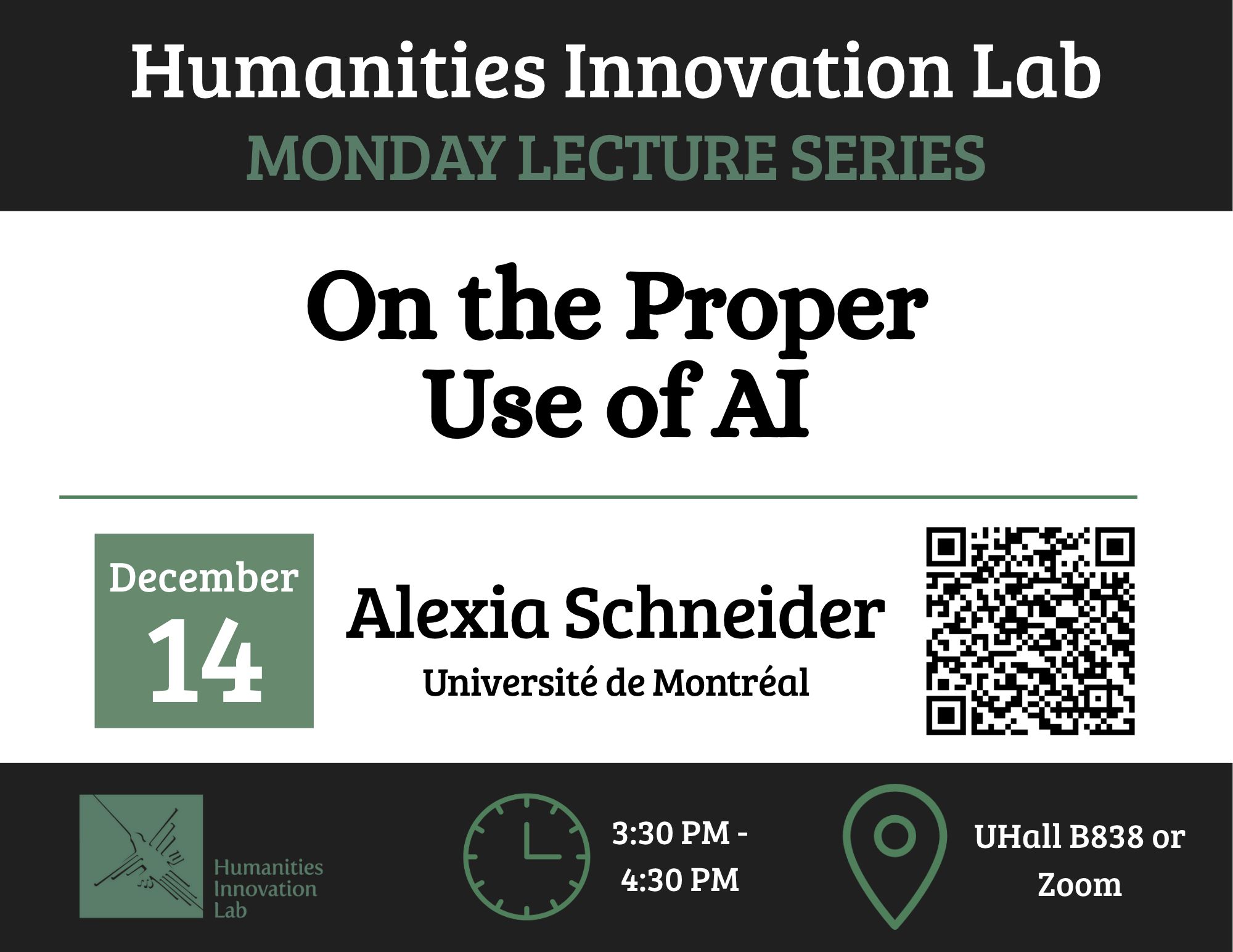
Monday Lecture Series: Alexia Schneider — On the Proper Use of AI
Alexia Schneider speaks in the lab’s 2026/2027 Monday Lecture Series on the proper use of AI.
- When: Monday, 14 December 2026, 3:30 p.m. – 4:30 p.m. MST
- Where: University Hall, room B838, University of Lethbridge — also streamed on Zoom
Abstract
Self-declarations of usage of generative AI are becoming common in research circles and classrooms, betraying a sense of unease surrounding undisclosed or discreet practices, aka “Shadow AI.” These considerations around proper or responsible usage of AI give us a sense of the growing tension between the implicit demands of academia. While on one side we still expect science to be based on trust and transparency, on the other, productive imperatives incentivize the delegation of fundamental — albeit tedious — parts of learning and researching.
This talk is a provocation on the notion of “proper use” in the current context of saturated public conversation about a handful of products. I will argue that we all believe our own usage to be the only one defensible, hinting at the fact that the only shared practice in this moment is the one of negotiating with oneself.
This talk will outline the growing pervasive use of language elements created by the LLMs and the companies selling chatbots about themselves and how this sheds light on the current shift from collective responsibility of AI regulation to the responsibility of individual practices.
About the speaker
Alexia Schneider is a doctoral candidate in Digital Humanities at the Université de Montréal. She is a student member of the Centre de Recherche Interuniversitaire sur les Humanités Numériques and of the International Observatory on the Societal Impacts of AI and Digital Technologies. She is also a member of the Research Laboratory on Digital Textualities.
She holds a BA in French Literature from Université Paris-Sorbonne, and an MA in NLP from the Université de Strasbourg. Her interests focus on research practices and AI research assistants; she develops tools that are not chatbots, and research environments that foster serendipitous findings.